BUILD-YOUR-OWN-WORKING...
|
|
Koptor
Playset |
Playset. Koptor
1924. A striking example of an early educational toy set. Developed in
England at the Taylor-Hobson Research Laboratories, it is designed to teach children
‘while they play.’ Condition: very good. Missing several pieces. Box has
heavy edge wear and splits. Instructions have some stains, tears and holes
but are presentable. $75 [ebay: 1.11 none found] - Dantiques “Toys, Antique,
General”: - appears to be a microscope-building kit |
koptor1.jpg |
|
Make A Clock |
Kit includes all the pieces to build your
own working clock including an instructional poster - 6+ |
schylling-MACL-2 |
|
Time Machine Rolling Ball Clock |
[don’t know if this is educational, but at least in
original form assembly from kit was a “daunting task”] Every minute new marble interacts with the existing
marbles to display the correct time using marble logic gates and produces
marble read out of time.- http://www.dansdata.com/timemachine.htm
- review with photos of item from Edmund Scientific's "Scientifics
Online", who sell it for a pretty-much-on-par $US49.95, ex shipping. It's made (well, currently licensed, at
least; Time Machines have been on sale since at least the late 1970s) by Can You Imagine (incidentally, they also make
the Airzooka) [“the premier
manufacturer of creative products”, they also have Timespan Clock, Virtual
Clock] - other links on site - http://www.stuartsinger.com/ballclock.htm
- Stuart's Rolling Ball Clock Page, The Place to be for info on Arrow
Handicraft Electric Ball Clocks. [site has details on inner workings, lots of
detailed assembly photos, a gallery of his collection // The Rolling Ball clock was the brainchild of
Harley Mayenschein. He patented the design and founded Idle Tyme Corporation
who manufactured these clocks before
the rights were sold to Arrow Handicraft. The Original Arrow Ball
Clock box says "Can be assembled in an hour." If you actually get a chance to assemble
an original kit, expect more like 3 hours. It's a daunting task if you aren't
good with assembly. Below are the assembly instructions. Click on the
thumbnail to see full size. assembly_01.jpg Arrow
Clock Kit box. I have some complete never-assembled original Arrow Ball
Clocks kit #675 still sealed in their original boxes. I also have some used
original Arrow Ball Clock kits for sale that I have reconditioned. // [new version from Can You Imagine] This new
version of the Electric Ball Clock retains many of the qualities of the
original with some changes. Assembly
is no longer required. Personally I enjoyed assembling the original version,
but some people would be daunted by the number of pieces when opening the
carton. assembly_01.jpg
Here's a really cool clock by Arrow that you do not see too often. It's
called the Domino Clock Kit #677. It uses 3 metal balls and 3 rows of Dominos
that rise and fall to represent the time. - [CYI clock
seen on eBay 4/15/05, BIN 41.50; 200+ returns for “ball clock”. 3 current
listings for “arrow ball clock”. Completed: $66.50, 22GBP |
assembly_01.jpg assembly_01.jpg |
|
Working Paper Clock & book |
TW |
|
|
Warded Lock - Tarquin Paper
Locksmith DIY book |
TW |
|
|
Lego Action Contraptions book
- Klutz |
TW |
|
|
tinfoil needle DIY
“phonograph” |
TW |
|
|
|
|
|
|
Boomerang |
Provenzo DIY
p53. Also see Dover book on boomerangs |
|
|
Boomerangs - Dover book |
TW |
|
|
Helicopter-Parachute |
Provenzo DIY
p169 - similar principle to airborne seed pods; Leonardo da Vinci outlined principles
of the parachute - DIY made of two paper strips twisted together, with
remaining ends splayed out as wings |
|
|
Parachute |
Provenzo DIY
p187, using cutout paper bag square |
|
|
propeller toys |
b/w scan:
propeller toy of 1500s; Cayley’s propeller toy, 1792 |
mcclary2.gif |
|
Penaud’s planophore; French propeller toy |
b/w scan:
Penaud’s planophore, rubber-band powered plane; French propeller toy of 1800s |
mcclary3.gif |
|
helicopter toy, 1878 |
b/w scan: helicopter
toy from 1878 Scientific American |
mcclary4.gif |
|
Paper airplanes |
TW |
|
|
White Wings planes kit |
TW |
|
|
Flite Rings kit |
TW |
|
|
Comet Porterfield 65 kit -
rubber band power, unbuilt |
TW |
|
|
Top-Flite P-51D Mustang |
remote control plane - PDF manual for
current Top-Flite P-51D Mustang model plane, with pix of the die-cut
patterns. This is a major RC hobbyist project, with a 60pp manual. The
construction mostly uses 1/8” plywood, with some balsa, e.g. sheets for wing
skins. 8.5 x 11 landscape format book, richly illus w/ b/w photos. “If any of
the die-cut parts are difficult to punch out, do not force them! Instead,
first cut around the parts with an X-acto knife.” |
topa0110-manual.pdf |
|
Technokit |
Technokit - Hovercraft Kit - Everything
required to build working electric hovercraft that really works. Emulate the
great Sir Christopher Cockerill in the comfort of your own home. Ages 8-12,
£9.95 (Technokits also Electric Buggy) - www.jammyjoes.com
Dorset (UK) toy shop |
hovercraft2.jpg |
|
|
|
|
|
Boy
Mechanic projects |
TW - engines,
mechanical power, building go-karts, harnessing mechanical power sources |
|
|
Stirling
Engine |
== need pic and description of what
it is http://www.stirlingengine.com/ -
American Stirling Company: beautiful Stirling engines and kits [ interesting,
a shrunk-down “toy” version of something serious. - From the FAQ:
Robert Stirling was a minister of the Church of Scotland who was interested
in the health of his parishioners bodies in addition to the well being of
their souls. He invented the Stirling engine (he called it an “air engine”)
because steam engines of his day would often explode killing and maiming
those who were unlucky enough to be standing close by. The modern uses of
Stirling engines are invisible to almost everyone. There have been many
research engines built in recent years but there are only three areas where
Stirling engines have made a dramatic impact. There are Stirling engines in
Submarines, stirling machines used as cryocoolers, and Stirling engines in
classrooms. Ford, GM, and American Motors Corp. spent millions of dollars
developing Stirling engines for cars, back in the 1970’s. Ford even built a
Stirling that could drive away from the curb (with relatively low power)
twenty seconds after you turned the start key! - You may always
use the pictures of our engines on the web if you include a link to our home
page http://www.stirlingengine.com . In print you may use our pictures if you
print a photo credit which says, “Used by permission of
www.stirlingengine.com” If you would like to re-publish our content in other
ways, please call us or e-mail us.] - MM-5
Coffee Cup Stirling Engine Kit Powered by hot coffee or ice cubes
- Ready to assemble. Pleasant 2 or 3 evening kit. $99 - This kit includes all
the parts to build our original transparent engine that sells ready
to run for $139.00 Read our online
instructions. [They also have one for $359 that runs on the heat of your
hand, or sitting on a computer monitor] |
|
|
|
|
|
|
homemade
amateur spark transmitter |
r_0170.jpg -
This is a typical homemade amateur spark transmitter mounted on a piece of wood.
The circuit is very simple but it works. - http://www.chss.montclair.edu/~pererat/mperadio.htm |
r_0170.jpg |
|
Early Crystal
Detector Radio Receiver |
r_0250 - Early Crystal
Detector Radio Receiver Circa 1920s: This receiver was built by a radio
amateur and consists of a “cat’s whisker” crystal detector and an extremely
unusual vertical loose coupler coil set. Turning the knob on the right causes
the center coil to go up and down, varying the coupling between the inner and
outer coils. - http://www.chss.montclair.edu/~pererat/mperadio.htm |
r_0250 |
|
Crystal set -
dad and lad |
may be a movie still,
shows presumably a dad and lad with a crystal set - http://www.northwinds.net/bchris/index.htm
- Surfing the Aether - timeline of radio history |
radkid.jpg |
|
Heathkit CR-1
Crystal Radio |
- Heathkit CR-1
Crystal Radio clone for sale. This lot includes the radio, a near mint set of
4000 ohm 1940’s vintage Trimm Professional Headphones and a hand made clone of the famous Heathkit
CR-1 crystal radio. The radio uses a dual tuned circuit system that has a 2
core coil wound with Litz wire and the same design and performance as the
original radio. $129 - Scott’s
Crystal Radios |
aaaheath6.jpg |
|
Loop crystal
radio |
A loop
crystal radio using computer ribbon cable -- “Perhaps my favourite
design,” says low-tech guru Doug Edwards. http://journeytoforever.org/edu_radio.html |
XTAL2a.jpg |
|
Rocket Radio |
see linkbase XSS
http://www.midnightscience.com/
- Xtal Set Society Remember playing
“Spy” with your spy pen radio when you were a kid? This little Rocket Radio
takes you back to those times too, digging through the Cheerios box hoping
the radio was in there. Some brilliant marketer with gobs of mullah (not us,
ha!) had these great remakes of the original 1950’s Rocket Radio made. It
really works, but be realistic, you’re not going to get Radio Japan on it!
Instead of the 1950’s look, these are packaged for “kids.” Get one for you
and one for the kids! Cat# XRR $12.00
- http://www.midnightscience.com/catalog8.html - (eBay)
rocketradio2.jpg, rocketradio3, rocketradio4, also rocketradio7-11 [OK to use
per email, credit design20c.co.uk] sold for GBP26 ($51) - (eBay)
rocketradio5.jpg - This auction is for an authentic vintage ad from a
1952 Magazine. This ad is from MARDO SALES of New
York. Ad features the LITTLE ROCKET
RADIO. This radio has no tubes or
batteries and needs no electricity.
It is powered by a tiny Germanium Diode. This is a black and white ad,
and measures approximately 1-5/8” x 2-3/4”. - (eBay)
rocketradio6.jpg - A1, made in Japan, no date given |
rocketradio.jpg rocketradio2.jpg rocketradio3 rocketradio4 rocketradio7-11 rocketradio5.jpg rocketradio6.jpg |
|
XSS Little
Wonder Crystal Radio Kit |
The XSS Little Wonder
Crystal Radio Kit - Our “Little Wonder” is a super starter kit for kids and
beginning adult builders! It tunes the entire broadcast band. The extra large
solder pads make it easy for beginning builders to have a successful first
radio. There are only a few solder
joints, and the pads are spread out making it clean and simple to
assemble. The “Little Wonder” was
designed especially for the XSS by our founder, Grampa Phil, W0XI. We tried to combine everything we’ve
learned about building radios with beginners and kids to create a radio that
everyone can build the first time.
There is no coil to wind, a high resonant frequency molded choke have
been used in place of the coil. A
nice photo diagram is included showing all the parts and their placement on
the printed circuit board (PCB) .
This radio is perfect for parents and grandparents to build with
kids. It is also priced right for
classroom use, and can be used to teach basic radio theory, soldering, and
handling of electronic parts and PCB’s. Kit includes a high impedance crystal
earplug. A super performer and a
great little kit; you’ve got to have one! XS402 $14.95.
[XSS] |
xsslittlewonder1 xsslittlewonder2.jpg |
|
Flights
of Fancy Crystal Radio kit |
$17.50 - see sci
kits |
|
|
Crystal Radio
Kit |
Only: $9.95 The
crystal radio was discovered in 1901. It is still the basis of modern-day
radio and communications equipment and lives on in a wide variety of radio
systems. Go back in time, and learn how radio detection was first done!
Without a battery or power supply, you will hear AM broadcasts with your
Crystal Radio Set! Crystal radios don’t need a power supply - they’re powered
by the radio station and are endlessly fascinating because of their
simplicity and their complexity! They contain so few parts yet display so
many concepts. The comprehensive 16 page manual covers everything from how it
works, why it works, and illustrated assembly instructions. Assembly is easy
with solderless connections, and no previous electronic experience is
necessary. Relive history with a Crystal Set today! - http://www.ramseyelectronics.com/cgi-bin/commerce.exe?preadd=action&key=CS2
Ramsey
Electronics - has lots of kits and PDF plan sets. Learning Kits include
($10-15) AM Radio, AM/FM Radio, Bell Action, Crystal Radio, Motor Action, and
($65) Ion Generator, Plasma
Generator |
CS2.jpg |
|
|
|
|
|
Simon |
[from blinkenlights: what was the first personal computer?]
Edmund Berkeley first described Simon in his 1949 book, "Giant
Brains, or Machines That Think" and went on to publish plans to build
Simon in a series of Radio Electronics issues in 1950 and 1951. Simon touched such pioneering computer scientists as
Ivan Sutherland, who went on to influence development of interactive
graphical personal computers.
By 1959, over
400 Simon plans were sold. |
|
|
Bell Labs CARDIAC |
The company that got the distribution rights to Bell
Labs educational products is ComSpace [http://hometown.aol.com/comspace/
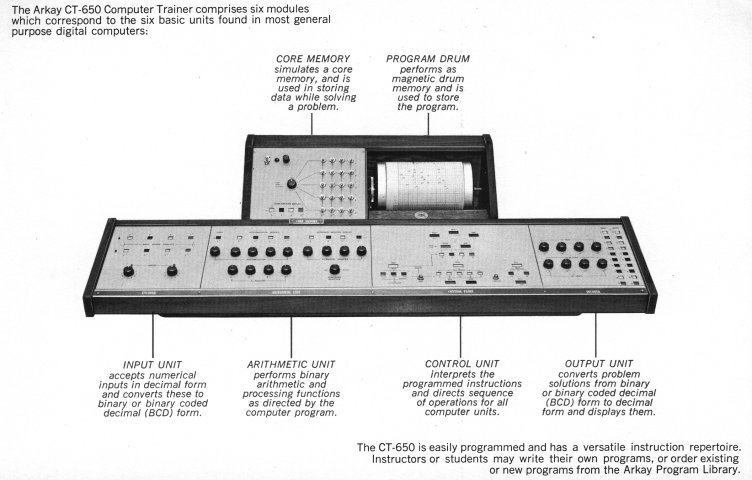
see Science Kits; blinkenlights sez “In 1969, a company called COMSPACE created a "professional" version of this
computer [which?] called the Arkay CT-650.”]. The
CARDIAC itself comes as a tri-folded piece of die-cut cardboard that unfolds
to larger than 11"x17". 2/3 of it are the main body, the last 1/3
is the moving parts - slides for the accumulator, the op code and two address
digits. cardiac4.jpg the assembled computer, ready to be
programmed. cardiac5.jpg
Close-up of the logic unit. cardiac.pdf
“Cardboard ‘Computer’ Helps Students” - One-page article from July 1969 Bell
Laboratories Record - “cardboard illustrative aid to computation” Update 5/13/02:
If you'd like to play with a CARDIAC without ordering one, and you don't mind
dealing with tar files, you might like to visit the cinc project,
which is building an emulator for CARDIAC. In addition to the CARDIAC, Comspace also has other educational aids and books
that were an outgrowth of Bell Labs science educational programs. |
cardiac4.jpg cardiac5.jpg cardiac.pdf |
|
Early toy
computers |
from http://www.vintage.org/exhibit99.html
VCF 3.0 Vintage Computer Exhibition (October 1999?): VCF_3.0_Doug_Salot_Exhibit.jpg - Doug Salot and his "Early Toy Computers"
- note Salot = www.blinkenlights.com
|
VCF_3.0_Doug_Salot_Exhibit.jpg |
|
Heathkit
Educational Robots |
from http://www.vintage.org/exhibit99.html
VCF 3.0 Vintage Computer Exhibition (October 1999?): VCF_3.0_Jim_Willing_and_Robots - Jim Willing and his "Heathkit
Educational Robots" |
VCF_3.0_Jim_Willing_and_Robots |
|
Edmund Analog
Computer |
TW has 1962 Edmund catalog p 98 - $14.95 - “It operates on two
flashlight batteries. Three potentiometers and an electric meter are mounted on
the diecut box. Two potentiometers are rotated and set at appropriate
numbers. The third is then rotated until dial reads 0. Position of that dial
then indicates answer.” - also G.E. Computer $29.95 - “Same accuracy and operational
procedure as Edmund Computer, only difference is that the Edmund is made of
cardboard and the G.E. is plastic... Memory panels and accurate audio
indicator with 3-transistor amplifier.” |
|
|
Tinkertoy
computer |
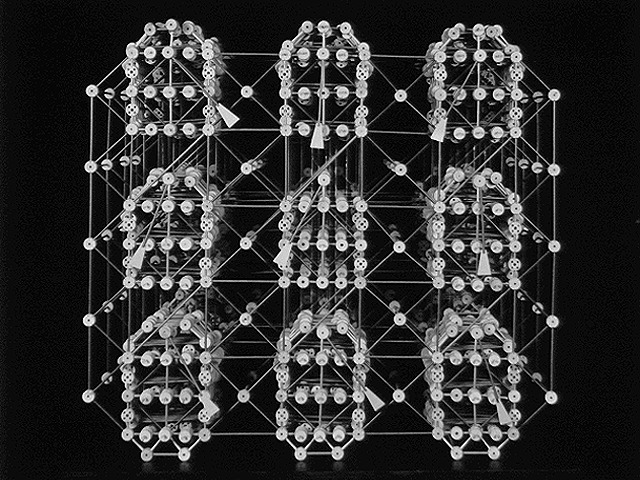
digicomp group, msg 635: the famous tinkertoy
tic-tac-toe computer that Danny Hillis, inventor of the Connection Machine,
and once CTO of Thinking Machines Corp., along with Brian Silverman, CTO of
Logo Computer Systems Inc. (LCSI), built back in the '70's. One of the two
prototypes, though no longer working, is on display in the lobby of the
Boston Museum of Science. http://www.rci.rutgers.edu/~cfs/472_html/Intro/TinkertoyComputer/TinkerToy.html
or JPG from http://www.blinkenlights.com/classiccmp/toy/tinkertoy.jpg
|
tinkertoy_computer.jpg |
|
Turing Train Terminal |
a calculating model train layout, in either HO or N
gauge scale (hard to tell from the pictures). Rather elegantly arranged, too.
- see digicomp.doc for description, calculating notes http://www.monochrom.at/turingtrainterminal/
- Turing Train Terminal presented at
freiraum/Museumsquartier Wien 2003/04 - 12.01.04 - 07.03.04 Severin Hofmann wallstreet@sil.at David Moises david@timesup.org - saved Chalcraft.pdf “Train Sets” by Adam Chalcraft
and Michael Greene, 5p article from unattributed source turing_pic09.jpg, turing_pic16, turing_pic15 - whole
display, layout closeup, keyboard turing_introeng - appears to be pictorial diagram turing_schematics.gif |
Chalcraft.pdf turing_pic09.jpg,
turing_pic16, turing_pic15 turing_introeng turing_schematics.gif |
|
|
|
|
|
difference
engine |
DIY
- great high-res photo of Tim Robinson’s magnificent red/green difference
engine built from Meccano, currently on display at the Computer History Museum
in Mountain View, California. - Tim
Robinson’s Meccano Computing Machinery - see linkbase for print refs,
other Meccano - MeccanoDifferentialAnalyser.jpg from http://www.csparks.com/gallery/Digi-comp [from digicomp group] Apparently, during the 30's
about 6 differential analysers were constructed mostly out of Meccano parts,
and used professionally. One of them (maybe the only remaining one) is part
of an exhibition in a museum in New Zealand; you will find more details (as
well as a picture) at the address: http:// www.maths.irl.cri.nz/history/analyser.jpg since my previous
message I found another page which gives more information on this
differential analyser: http://users.actcom.co.il/~anthias/ |
DEFront.jpg MeccanoDifferentialAnalyser.jpg |
|
|
|
|
|
Geniac |
(eBay) Before there were computers there
were Geniacs. This kit is titled:” Geniacs: Simple Electric Brain Machines
and How To Make Them.” This is from the1950’s. We slit the box open so we are
pretty sure it is all there. There is a large wooden framework to assemble to
hold the kits and there are parts and directions to build several (dozens) of
electric brain machines. Some of the projects listed are:Intelligence Testing
Machine; Combination Locks; Reasoning Machine; Secret Decoder, Coder;
Translator from Binary to Decimal; Translator from Decimal to Binary; Binary
Adding Machine; Binary Multiplying Machine; Machine for a Space Ship’s
Airlock; The Fox, Hen, Corn, and Hired Hard: Farmer’s Machine; The Machine
for the two jealous Wives; and many others. Practical things like burglar
alarms and signalling machines can also be built. There are six envelopes
filled with parts of various kinds. 11/29/04 - sold 218.00 http://cgi.ebay.com/ws/eBayISAPI.dll?ViewItem&category=4193&item=5151934891&rd=
1&ssPageName=WDVW - supposedly “double” set, starting at $495 Box shipped from Oliver Garfield, 126
Lexington Ave, NY - The 1958 Geniac ad says he “co-created” the kit, lists
him as author of “Minds and Machines”, editor of the “Gifted Child Magazine”
and the “Review of Technical Publications”. |
geniac-ebay etc. |
|
Geniac kit, 1957 |
1957 model |
geniac57.jpg |
|
Geniac console |
good closeup of
console - http://trevor.butler.edu/~bwoodruf/pers/geniac/geniacac.htm |
geniac57-2.jpg |
|
Geniac ad |
ad from
Astounding Science Fiction (1958), “Build 125 Computers at Home with GENIAC”;
“text prepared by Dr. Claude Shannon” - http://www.computercollector.com/archive/ |
geniacamazing-s.jpg |
|
Geniac ad |
actual ad from July
1957 Analog Magazine (or per the page title, July 1957 Astounding Science
Fiction) - waterstained but big print - http://trevor.butler.edu/~bwoodruf/pers/geniac/geniacac.htm |
geniackit.jpg |
|
Brainiac |
(eBay) For
auction is the ORIGINAL first personal electrical computer ever designed and
built in 1959 by Edmund C. Berkeley. This is possibly the most treasured item
by any collector of computer items. BRAINIAC was an educational toy billed as
a “computer” designed and marketed by Edmund C. Berkeley from 1959 through
the sixties. The name stood for Brain-Imitating Almost-Automatic Computer.
Widely advertised in science and electronics magazines, the BRAINIAC provided
many youths with their first hands-on introduction to computer concepts and
Boolean logic. Priced at about $20 in 1959 BRAINIAC was
far ahead of its time. It basically was a collection of configurable
(“hard-wire programmable”) N-pole by N-throw rotary switches, which could be
set up and cascaded to perform logical functions. The reason I say “N-pole”
is that the switches were made of drilled masonite disks that you might wire
as a many-pole two-throw, or single-pole multi-throw, depending on what
logical function you were implementing. The kit came with a pretty good
tutorial, which, as I look at it, is still useful today. The projects started
with basic logic circuits and progressed to such things as a NIM machine and
TIC-TAC-TOE machine. Back in 1959 the idea of making a machine that could
play even the simple game of tic-tac-toe was just amazing. The “output”
device was a set of lamps that would light in response to the “input data”
(switch positions) and “program” (how they were wired). http://cgi.ebay.com/ws/eBayISAPI.dll?ViewItem&category=1247&item=5141121797
- ended BuyItNow at $300; 4 prev bids up to $50 This naming convention carried over into
the field of small training machines for hobbyists. Most of these were
marketed by Berkeley Enterprises in the 1950s. All were based on the Geniac
(Genius Almost-Automatic Computer), an electromechanical contraption using
odd rotary switches. This led to Tyniac, Weeniac, and finally to Berkeley’s
notorious Brainiac (Brain-Imitating Almost-Automatic Computer). Brainiac
didn’t have much, if any, real computing power, but it apparently had
limitless semiotic power, permanently injecting into the mass consciousness
the concept of a “Brainiac” for a walking computer (later a nerd or a
propellerhead). Brainiac became the name of a TV character, and at least one
very entertaining robot-rock band. - http://www.ominous-valve.com/tubes1.html
- see linkbase |
brainiac1 brainiac2 |
|
Calculo Analog Computer |
(eBay) 1959 - Science Materials Center -
Basic intro to computer theory, math physics and mechanical drawing. Solves basic
math, square roots, compound interest, powers, trig functions, range of
projectile and more! http://cgi.ebay.com/ws/eBayISAPI.dll?ViewItem&category=1182&item=5138820371
- $306 |
calculo1 |
|
Digi-Comp
I Digi-Comp
II |
See digicomp.doc for list of Digicomp/ESR
resources, simulations, etc. - besides listed, more in DigiComp folder Digi-Comp II - per Yahoo group, DG2 sold 5/20/00 for $1525!!! - eBay 2/05 digicomp2.jpg - appears a bit ratty, not quite the same as depicted
on box front, but the first I’ve seen on eBay. Went for $214.50 - 5/23 $516 |
digicomp2.jpg digicomp2b digi_comp1_set1 |
|
Wooden
DigiComp |
woodendc1-1, woodendc1-2.jpg from http://www.rdrop.com/~jimw/jcgm-vcfii.shtml
little but larger photos no longer there BIG woodendc1-3.bmp from http://members.tripod.com/~km88mph/images/vcf2-04.jpg
- built by Doug Coward of the Museum of Personal Computing Machinery, with
plans supplied by Tom Stepleton at http://galena.tjs.org/digicomp/. |
in /DigiComp/ woodendc1-1, woodendc1-2.jpg woodendc1-3.bmp |
|
Digicomp Computer Kit (1963) |
Digicomp
Computer Kit (1963) - http://www.computermuseum.li/Testpage/01HISTORYCD-Subject-Index.htm#ComputerToysAidsGames |
DigiComp1.gif |
|
Digicomp Computer Kit (1963) |
Digi-Comp saved
DigiComp.gif and DigiComp1-closeup.gif from http://is.lse.ac.uk/History/Digicomp-Kit-1963.htm
- Lexikon Services "History of Computing" - maybe already
had them |
DigiComp1-closeup.gif |
|
more DigiComp pix |
http://www.csparks.com/gallery/Digi-comp
[now this is an amazing, eclectic site: software engineer for a
company that makes industrial automation, testing and simulation machines,
fixes watches, collects weird stuff. Check out the photo album/comment software Gallery v1.4-pl2 from http://gallery.sourceforge.net/
digi2box.jpg - DigiComp 2 box digicomp2c.jpg - b/w but excellent oblique studio shot of DB2 setup digicompII.jpg - color, shows top-on view of DB2 layout Digicomp1_side.jpg - color studio shot, wish it were larger Digicomp1_rear.jpg digicompParts thumb.jpg - misc, shows tubes, printed cards, spring |
digi2box.jpg digicomp2c.jpg digicompII.jpg Digicomp1_side.jpg Digicomp1_rear.jpg digicompParts thumb.jpg |
|
Mark 106 (Hasbro) |
(eBay) This is a later version of the
Think-A-Tron (which I also have on Ebay). By Hasbro dated 1968 It is rarer
than the original – and that’s rare too! Electronic Q & A game. 11/21/04 - [item has rummage price $2 on
front] sold 38.00 |
mark106a mark106b |
|
Minivac 601 |
Minivac 601, from Scientific Development Corporation.
This was not a small car vacuum, but instead a rather remarkable breadboard
assemblage, about the size of a mixing console, that could be hand-patched to
implement various binary and boolean circuits. It used DPDT telephone relays,
6 of ‘em, and a single, motor-driven, rotary switch. Minivac did even less
than Brainiac, but it was cheap and immortal, and the big, high-current
relays made great control interfaces for things. I was given a used one at
one point. It made a good Morse code sender, not that much unlike the “CQ
wheels” used by commercial stations. - http://www.ominous-valve.com/tubes1.html
- see linkbase Addendum: Minivac
pictures -
http://musee.ordis.divers.free.fr/ http://www.smecc.org/logic_trainers_&_simple_computers.htm
http://computermuseum.obi-datentechnik.de/comp_scientific.htm
http://retards.org/library/technology/vintage/minivac_6010/
http://www.computermuseum.20m.com/minivac.htm
http://www.onlineglendale.com/logic_trainers_&_simple_computers.htm http://www.technikmuseum-main-taunus.de/geraete/minivac.htm - Minivac wired
up for tic-tac-toe http://www.laemmlin.ch/gallery/archives/2004/09/129_kanada1jpg.html (eBay) none
found |
minivac.gif |
|
|
|
|
|
Fischertechnik
Mobile Robots Kit |
Fischertechnik Mobile Robots Kit The next generation of Fischertechnik robotic
construction sets let you build intelligent robots. Plans present six mobile
robots that exhibit edge and collision detection, light seeking, and line
tracking capabilities, as well as other fixed models. Over 350 pieces
including 2 motors, 6 touch sensors, 2 light sensors, a lamp, the battery
power block and instruction manual. Requires six AA cells. Requires Lucky
Logic Software and Intelligent Interface and Adapter (sold separately)
[not found on the site]. Unleash your creativity with Mobile Robots! The
Fischertechnik system was originally developed in Europe as a prototyping
tool so engineers could rapidly create, modify and refine operating models of
industrial equipment. It is far more than “Legos for adults”. The pieces lock
together and stay there. Many components include metal for extra strength.
The electronic systems include temperature sensors, LEDs, motors and more.
The programming is fast and powerful. Robot Store (Mondo-tronics Inc). PMB-N, 4286 Redwood Highway, San Rafael,
California, 94903, USA. Tel: 415-491
4600; fax: 415-491 4696; email: info@robotstore.com; web: www.robotstore.com . -see linkbase Robot Kit categories include; Listening, Touching
and Seeing Robots, OctoBot Survivor Robot
Kit, RoboBRiX™, Robot Arms, Legged Robots, Wheeled
Platforms, B.E.A.M. Robotics, Programmable Robots, Hackable Robot Kits, LEGO Mindstorms Kits, Fischertechnik Reconfigurable Robot
Kits, Animatronics. Other Categories
incl. Robot Pets, Electronics, Mechanical |
3-620_fisch_mobrob.jpg |
|
FischerTechnik PROFI kit |
TW |
|
|
Lego Mindstorms |
TW |
|
|
Muscle Wires® |
“Muscle Wires®
are thin, highly processed strands of a nickel–titanium alloy called Nitinol –
a type of Shape Memory Alloy that can assume radically different forms or
“phases” at distinct temperatures. At room temperature Muscle Wires are
easily stretched by a small force. However, when conducting an electric
current, the wire heats and changes to a much harder form that returns to the
“unstretched” shape – the wire shortens in length with a usable amount of
force.” Besides Muscle Wires® you can obtain Nitinol, NanoMuscle™, BioMetal -
Robot Store www.robotstore.com |
|
Home Descriptions/compilation
©2005 Tim Walker. Direct quotations and images cited under fair use remain the
property of original copyright holders.